






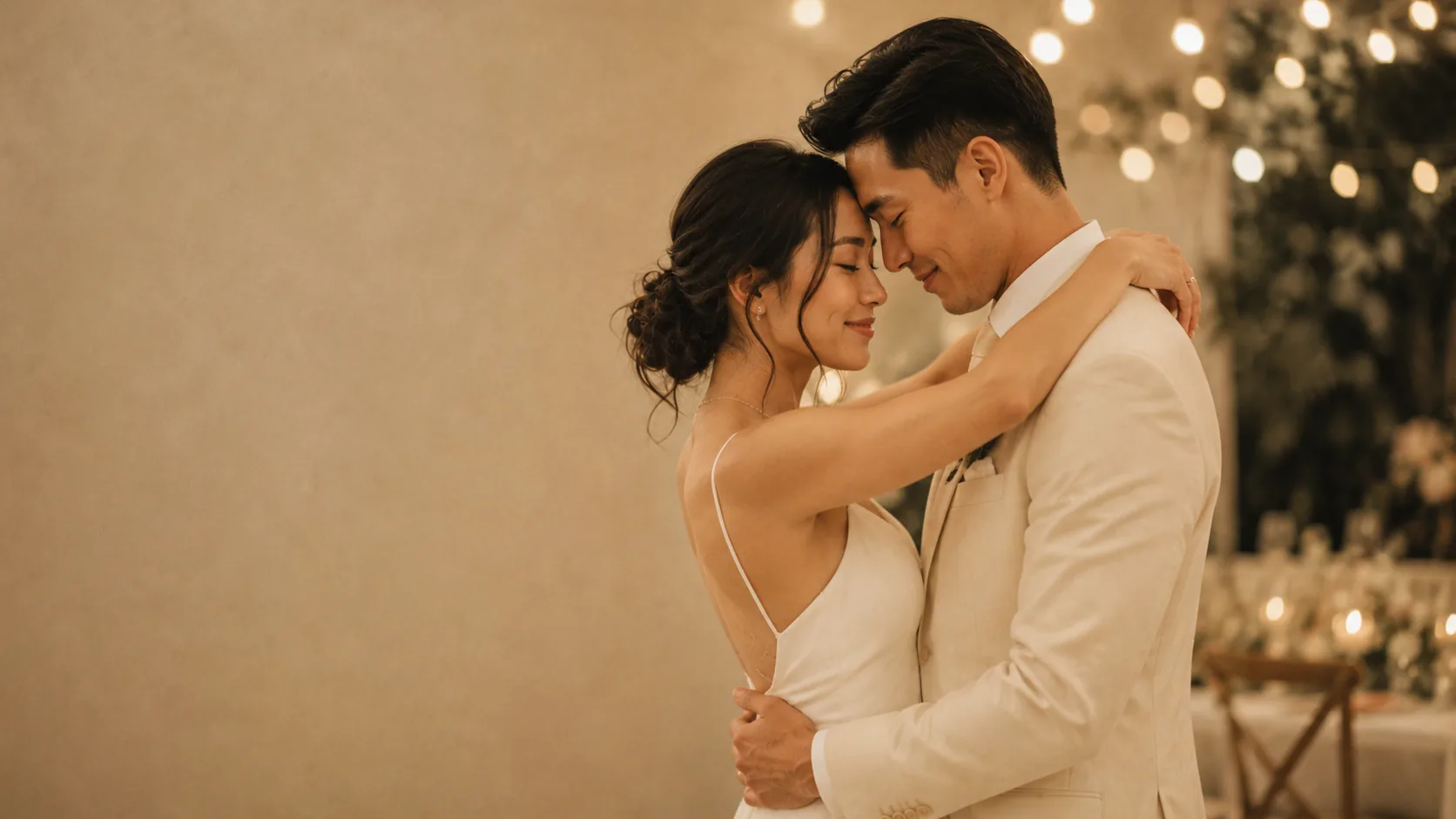


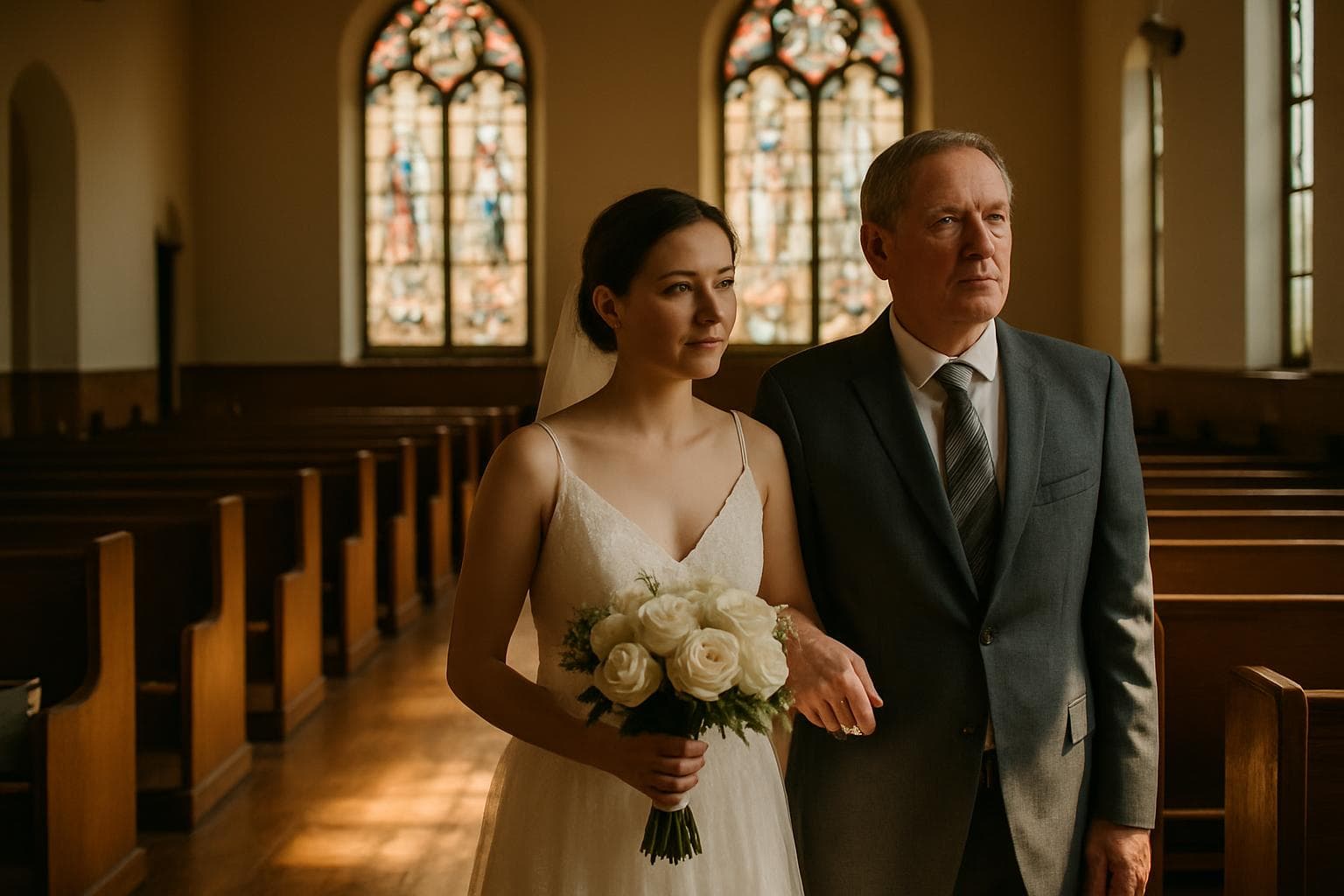

The song playing while the bride walks down the aisle is the one every guest in the room hears. It's the song the photographer shoots to. It's the song the mother of the bride will remember for the rest of her life when she closes her eyes and pictures that moment.
Most couples leave it to a Spotify wedding playlist. Something instrumental. Something safe. Something that could have been playing at any wedding, for any bride, in any church, in any year.
A personalized processional song written for the actual bride walking down the actual aisle does what the Spotify default can't — it names her. It names the church. It names the man waiting at the altar. By the time she's halfway down the aisle, the room knows this song was written for this walk.
Here's what that looks like, and why brides keep telling us they wish they'd ordered it sooner.
Why couples regret the Spotify processional
The processional is the one song in the wedding where every guest is already paying attention. Phones are down. Conversations have stopped. The room is watching one woman walk toward one man.
And then the song starts — and it's the same instrumental version of "Canon in D" that played at 40,000 other weddings this year.
The song isn't bad. The song is beautiful. But the song has no connection to the couple, to the venue, to the story. So the bride is doing the emotional work in real time — trying to make herself feel about this moment what the song is telling her she should feel.
A personalized processional does the opposite. The song already knows who she is. The bride just walks.
Here's a quote from a bride we worked with last fall (Sarah, Fredericksburg, VA):
"I ordered the processional song three weeks out. My DJ said it was the first time in six years he'd played a song at a wedding where guests asked him after the ceremony what the song was called. Half of them thought we'd hired a live singer."
That's the tell. When the song is written about the actual people in the room, the room leans in.
Three directions for a processional song
Pick one based on whose voice you want singing as she walks. All three work. All three have been played at weddings we've written for.
From the groom — watching her walk toward him
First-person POV. 'I've been standing here for twenty minutes / but the door just opened and time stopped.' The song is what he's thinking as she comes down the aisle. Works best when you tell us what he noticed first — the dress, her smile, the flowers, the fact that she's crying already.
From the father — giving her away
Retrospective POV. 'I walked her to the car a thousand times / but this walk is different.' The song is what he's feeling as he realizes this is the last walk as her primary protector. Works best when you give us one memory from her childhood and one detail about the groom by name.
Dual POV — alternating verses
Verse one: groom. Verse two: father. Bridge: both. This is the format that makes half the wedding cry. The song starts as a love song, pivots to a father-daughter moment, then ends with both men singing about the same woman from different angles.
The dual-POV format is the one we get asked for most — verse one from the groom, verse two from the father, bridge from both. It's also the format that makes half the wedding cry, because the song starts as a love song, pivots to a father-daughter moment, then ends with both men singing about the same woman from different angles.
For more examples of how the dual-POV structure works, see the full collection in our wedding song hub — we've written processionals from every possible angle.
A real bride-walking song — from both sides
This is the song that ran at a wedding in rural Virginia last September. Bride (Sarah) walking down the aisle at a small country church. Groom (Jake) at the altar. Father (Mike) walking her down.
The couple ordered three weeks out. They gave us five details: the church name, the fact that Sarah was wearing her grandmother's veil, the September timing, Jake's POV for verse one, and Mike's POV for verse two with one line about handing her off to Jake by name.
We wrote it as a country ballad — verse one from Jake watching her walk toward him, verse two from Mike walking her down, bridge from both. 2:52 total length. Slow tempo because the aisle was long.
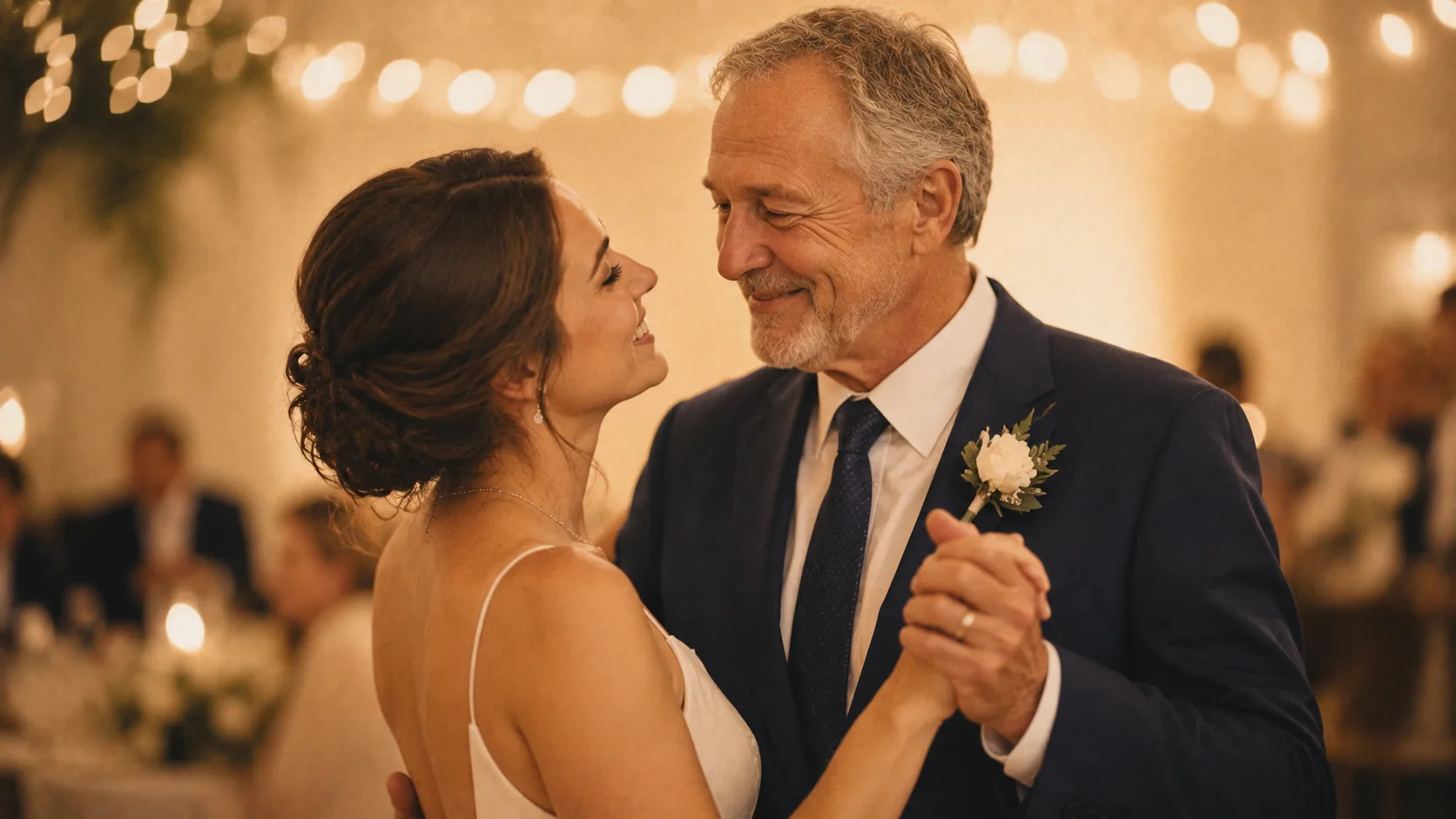
Stood on My Boots
Example brief
“Wedding processional. Bride: Sarah, 28. Groom: Jake, 30. Walking down the aisle at a small country church in Fredericksburg, VA. Sarah's wearing her grandmother's veil. Dad (Mike) is walking her down. Song from Jake's POV in verse one (watching her walk toward him), then Mike's POV in verse two (walking her down), then both in the bridge. Style: country ballad, warm male vocal, fingerpicked acoustic guitar, slow tempo for long aisle. Mood: emotional but not weepy, grateful, proud.”
The song played as Sarah walked. By the second verse half the room was crying. The DJ told the couple afterward it was the first processional in six years where guests came up to ask what the song was.
What makes a processional brief work
The strongest processional songs share five details. If you can give us all five, we'll write something no other wedding will ever play.
The venue by name — not just 'the church'
St. Mary's in Cleveland. The barn on County Road 12. Her parents' backyard in Napa. The song that names the place pins the moment to the actual ground. Generic church references sound like stock footage.
What she's wearing that he didn't expect
The veil her grandmother wore. The boots under the dress. The something-blue bracelet. The fact that she's barefoot. These are the details the groom notices in real time as she walks — put them in the song.
The one thing the father almost said but didn't
Most fathers of brides rehearse a sentence in their head they'll never say out loud. 'I knew this day was coming but I didn't think it would be this hard.' The song can say it for him. Tell us what he hinted at during the rehearsal dinner.
The moment they met — from his side
Coffee shop. Mutual friend's wedding. College library. Tinder (yes, we write this). The groom's verse works best when it references the first time he saw her and connects it to this moment — 'seven years ago in a bar on Ninth Street / and now you're walking toward me in white.'
The groom by name — if the song is from dad
Naming the groom in the father's verse signals that dad approves, that the handoff is intentional. 'I'm walking her to Tom today / and I know he's the one who'll stay.' That line does more emotional work than three paragraphs of a toast.
These five details are the difference between a generic processional that could be about anyone and a song that stops the room. The venue name pins it to the actual ground. The unexpected wardrobe detail gives the groom's verse something concrete to notice. The father's unspoken sentence becomes the lyric he'll never say out loud but everyone in the room will hear. The meet-story anchors the groom's verse in the timeline from first meeting to this moment. And naming the groom in the father's verse signals approval — dad is handing her off intentionally, not reluctantly.
When to order the processional
Most couples order the processional song two to four weeks before the wedding. That gives you time to send the MP3 to your DJ or sound tech, test it during rehearsal, and request one free revision if you want a line changed.
We can also handle one-week-out orders. About 40% of our processional songs are ordered in that window — couples who tried the Spotify default during rehearsal and realized it didn't fit.
The 30-minute delivery window means you can order Monday and have the song by Tuesday morning. Plenty of time to make it part of the ceremony even if the wedding is Saturday.
Comparison — processional options ranked by effort and outcome
Here's how the five most common processional approaches compare. ReadyMuse sits in the middle — more personal than Spotify, faster and cheaper than a live musician.
| Option | Setup effort | Cost | Personalization | Timeline | Best for |
|---|---|---|---|---|---|
| Spotify instrumental | Minimal (playlist link to DJ) | Free | None | Same day | Couples who want traditional and safe |
| Spotify pop song | Minimal (playlist link to DJ) | Free | Low (song about love, not them) | Same day | Couples who want recognizable |
| Live musician (hired) | High (coordinate with venue, rehearsal) | $300–$800 | Medium (can choose song, no custom lyrics) | 2–6 weeks | High-budget weddings with acoustic preference |
| Custom songwriter (commissioned) | Very high (back-and-forth on lyrics, recording) | $1,200–$3,000 | High (fully custom) | 6–12 weeks | Couples planning a year ahead |
| ReadyMuse personalized song | Low (brief form, MP3 delivered) | Free (daily slots) or $49 | High (names, venue, story) | 30 minutes | Couples who want personal without the timeline |
The personalized song from ReadyMuse sits between Spotify and a commissioned songwriter — you get the custom lyrics and the specific details, but without the six-week timeline or the $1,200 price tag.
Write the song she walks down the aisle to
Personalized processional song · Your story · MP3 in 30 minutes
Get our free processional song10 free slots daily · Resets at midnight EST
Questions about processional songs
More birthday song ideas