














Walking across that stage takes thirty seconds. The four years that got them there don't compress into a card. Most graduation gifts try anyway — a frame, a check folded into a card with the same five words your aunt wrote when she graduated in 1987. They mean well. They don't land.
A personalized graduation song lands because it does what every other gift can't: it names the specific things only you know about this graduate. The way they walked into kindergarten and didn't look back. The Tuesday playlist with their best friend. The fight about their major that they turned out to be right about. Five details, three minutes of music, a song they'll keep on their phone for the next ten years.
Below are real graduation song examples covering the relationships that send the most personalized song orders — daughter from her dad and from her mom (Latina country-pop, first-gen), son from his dad, the parents' upbeat surprise, best friend, the whole class, and the graduate's thank-you to mom and dad. Each one comes with a free MP3, a brief example you can use as a template, and a breakdown of why the hook works.
The graduation playlist — listen to all 7 songs
Click any song to play. The bar follows you as you scroll. Auto-advances to the next track.
Why a graduation song lands harder than a card or a check
A check disappears the day it gets cashed. A frame ends up on a parent's shelf, not the graduate's. A graduation card gets read once and stuck in a drawer with the eight other cards from the same week.
A song works because of three things a card structurally can't do.
It plays. A graduation song has a chorus with the graduate's name in it. They'll listen to it once on graduation morning, then again at a stoplight a week later, then again at a low moment six months in. A card does not get replayed.
It names them. "Congratulations on your big day" is a category. "Go on, Hannah, go on" is a hook. Personalization isn't a marketing word — it's a structural difference. Names go in the chorus. Specific moments go in the verses. Generic songs don't survive the first listen. Specific songs survive the decade.
It says the thing nobody knows how to say out loud. Most parents and friends can't say "I'm proud of you" without sounding either drunk or fake. A song says it for them — by not saying it directly. The dad's hook is "Go on, Hannah, go on." Not "I love you." Not "I'm proud." Just go on. That's how dads say it.
For a daughter — the piano song from her dad
The dad-to-daughter graduation song has one trap and one secret. The trap: writing a tearjerker. Dads aren't tearjerkers. The secret: one crack in the voice on the very last line carries more weight than three minutes of open emotion.
The right vocal register is piano-led adult-contemporary, not country. Country dads bless their sons. AC dads quietly admit something to their daughters. Different language, different tempo, different key. The hook on Hannah's song is "Go on, Hannah, go on" — three words, name in the middle, said the way a dad says it at the end of a phone call when he doesn't want to hang up first.
What works in a dad → daughter graduation song
The first day of kindergarten when she walked in and didn't look back ("that was my first lesson"). Teaching her to ride a bike — the exact moment he let go of the seat. The dorm move-in day, an empty room when he got home. One detail per verse, no more. The bridge is where the song shifts: from observing her ("today I watched you walk again") to addressing her directly ("I taught you how to leave / I never taught me how to let you").
Avoid: "my little girl," "where did the time go," "you're going places." All graduation card phrases — none of them survive on a real song.
Example brief
“For my daughter Hannah, on her college graduation. From her dad. She walked into kindergarten and didn't look back — that was my first lesson. Move-in day at the dorm I came home to an empty room. Style: piano-led singer-songwriter, warm male vocal, restrained, not country.”

Graduation song for a daughter — from her dad (Hannah)
For a daughter — the Latina country song from her mom
A mom-to-daughter graduation song lives in a different register than a dad-to-daughter song. Where the dad version uses go on — restraint, blessing — the mom version is allowed to name the specific objects in the daughter's life and the specific people watching from the next generation back. The Maya song does this in the most concentrated form in the catalog: "Mija, your quinceañera dress is in the closet / la abuela said you'd be the first to go."
The cultural specificity is what makes this song land. Maya is the daughter of a Latina mom, the granddaughter of an abuela who watched the whole arc from a different country. She's a first-generation college student leaving for nursing school in Knoxville. The song's hook is "Mija, drive — la abuela's praying for you / Mija, drive — the truck's got a full tank too." Bilingual touches without forcing them. Mija and abuela in the chorus. Siempre in the outro. The song's spoken intro is four sentences, eleven seconds: "Mija. You leave for Knoxville on Sunday. Your abuela's prayer card is on the dashboard. I love you. Drive."
What works in a Latina mom → daughter graduation song
Three generations on the page (mama, mija, abuela). One culturally specific object that anchors the song (the prayer card on the dashboard). The first-generation pride beat handled without inflation: "first in the family, first in the school" — said once, plainly, as a fact. The bridge is the song's hardest line: "I won't say it loud — I'll let you go." The mom acknowledging she has to do the dad thing — the letting-go thing — even though her instinct is to hold her daughter and not stop. That single line earns the chorus all over again.
Avoid: forcing Spanglish where it doesn't belong (the brief should specify which Spanish words actually live in the family's day-to-day — mija and abuela are universal, deeper code-switching needs to be earned). Avoid: erasing the cultural specificity to make the song "safe" for non-Latina listeners. The specificity is the song.
Example brief
“For my daughter Maya, on her high school graduation. From her mom. First in our family to go to college — leaves for nursing school in Knoxville this fall. Her quinceañera dress in the closet, her abuela's prayer card on the dashboard, the road north. Style: Latina country-pop, accordion, warm female vocal, bilingual touches.”

Graduation song for a daughter — from her Latina mom (Maya / "Mija, Drive")
For a son — the country song from his dad
Country-folk is the right register for a dad-to-son graduation song. The hook on Jake's song is "That's my boy, that's my Jake" — a mirror pair, the country structural equivalent of a toast. The name lands as the rhyme. The melody on the second half repeats the first.
What makes the country dad song work is the same thing that makes the piano dad song work: restraint. The spoken intro is two short sentences ("Your mom cried twice today. I told her once was enough."). The chorus says that's my boy instead of I love you. The bridge has one sincere beat — "I saw your mother's eyes light up today" — and then immediately moves back to the blessing: "Go on now, son. The world's waiting."
What works in a dad → son country graduation song
Teaching him to drive (specific road, specific car, the moment he held the wheel without help). Fishing trip, the time they argued and made up. The chorus is built around two anchor phrases: that's my boy (proud) and go on, son (release). The bridge: one moment that grounds the whole song. Not a monologue — one sentence. "I wasn't always the dad I wanted to be / but you turned out better than I dreamed." Then back to the chorus.
Avoid: "be a man," "make me proud," "the world is yours" — country clichés that no real country dad would actually say.
Example brief
“For my son Jake, on his college graduation. From his dad. I taught him to drive on the dirt road behind our house. We fought about his major, he was right. Today his mother's eyes lit up when he walked across the stage. Style: country-folk, fingerpicked acoustic, dobro, brushed drums, warm male baritone.”

Graduation song for a son — from his dad (Jake)
When the parents order the surprise — the upbeat pop song
Not every graduation song is restrained. Sometimes the parents don't want the piano-and-tears version — they want the song that plays on the kitchen Bluetooth at 9 AM on graduation day, full volume, while the graduate is still in pajamas and the coffee is still brewing. Pure celebration. Handclaps. Hey Emily, you did it, you won.
This is the upbeat-pop-surprise variant — the song commissioned by parents as a literal surprise gift, played for the first time at the family breakfast or the post-ceremony dinner. It's the closest thing in the graduation catalog to a Happy Birthday moment: short verses, a chorus made to be sung along to, family-group harmonies on the second chorus. The song is for everyone in the room, but the chorus has the graduate's name in it five times.
What works in the parents' upbeat-surprise song
Specific narrative beats that anchor the celebration in their actual story (four years, three cities, late nights, coffee, doubts in the rearview) instead of leaving it on generic you did it energy. Family-group harmonies on the second chorus and bridge — that's where the "yeah Em! we knew it!" shout-along enters. A second-line shift in the bridge to break up the chorus repetition ("that stubborn streak? best thing ever").
Avoid: thinking that the upbeat version means no specifics required. The opposite is true — upbeat songs need specifics even more than restrained songs do, because the energy alone won't carry generic lines. Three cities, one stubborn dream lands; you worked so hard doesn't.
Example brief
“For our daughter Emily, on her college graduation. A surprise from her parents. Four years, three cities, one stubborn dream — packed the car and moved again and again. Late nights, coffee, doubts in the rearview, but she always pulled through. Style: upbeat synth-pop, energetic, handclaps, female vocal with family-group harmonies.”

Graduation surprise — from parents (Emily's Big Day)
Make theirs in time for the ceremony
Personalized lyrics · Your music style · Free, delivered in ~30 minutes
Get a free graduation song →10 free slots daily — even if graduation is this weekend
For your best friend — the indie-pop "we made it" song
Best-friend graduation songs have to thread one specific needle: friendship, not romance. Sophie's song works because it sounds like every group chat the two of them have had since freshman year. The hook is "Same us, Sophie, same us" — a mirror pair with the name in the middle, anchored by a triple monorhyme inside the chorus: us / bus / trust.
The spoken intro reads like a voice memo: "Sophie. Remember the parking lot? The Tuesday playlist? The cafeteria fries? Okay. Don't cry. Press play." That's the whole template — three specific shared things, then press play. The verse fills in the in-jokes the family group chat would never get.
What works in a best friend → best friend song
Specific shared in-jokes only the two of you would understand — the parking lot, the Tuesday playlist, the cafeteria fries are placeholders for the actual ones in your life. The first-day-of-school memory. The moment you became inseparable. The fact that you're now going to different cities. The promise: "no matter the area code we're still us."
Avoid: anything that sounds like a love song. Best-friend songs lose their shape the moment they slip into "you complete me" register. Stay in the in-joke register, the I'd take a bullet but also I'd roast you for taking the wrong exit register.
Example brief
“For my best friend Sophie, on our graduation. From her best friend. We met on the first day, sat alone, became inseparable. The parking lot, the Tuesday playlist, the cafeteria fries. Now she's going to one city and I'm going to another. Style: indie pop, plucked guitar, handclap chorus, layered female vocals.”

Graduation song for a best friend — from her best friend (Sophie)
For the whole class — the anthem
Class graduation songs have to do something almost no other personalized song has to do: stay generic enough that every member of the friend group hears themselves in it, while still feeling like their specific group. The trick is collective "we." First-person plural. Nobody's named in the chorus — but everyone in the room is.
The class anthem hook is "We walked in strangers, we walk out home" — repeated twice in the chorus, then sung as gang vocals on the final chorus. Anthemic indie-rock with drums forward and an 80s synth pad on the chorus. The structural reference is The Killers, Lord Huron, Mt. Joy. The "closing credits of a coming-of-age movie" register.
What works in a class anthem
Universal high school details that feel specific even though everyone has them: hallway lockers, Friday night games, the one teacher who mattered. The line "four years they told us would fly / they were right and they were wrong" is the move — naming the cliché, then complicating it. The bridge gets quiet for two lines, then gang vocals come in on the final chorus and the whole room sings along. That's the part that gets played at the after-party.
Avoid: specific names (kills the "we"), inside jokes that only three people get, "the future is bright" / "spread your wings" — every clichéd line that's been on a graduation cap since 1995.
Example brief
“For our graduating class — friend group of five. From all of us. Hallway lockers, Friday night games, the one teacher who mattered. Four years they told us would fly. They were right and they were wrong. Style: anthemic indie-pop-rock, drums forward, 80s synth pad on chorus, male lead with female harmonies, gang vocals.”

Graduation class anthem — "We Walked In Strangers, We Walk Out Home"
From the graduate to mom and dad — the thank-you song
The role-reversed graduation song is the one parents don't expect. Almost every graduation gift moves from parent → graduate. This one moves the other way — from the graduate, to mom and dad, on graduation day.
The structural device that makes this song work is parallel hooks on two addressees. The chorus says "You crossed the stage today, mama / you crossed the stage today, dad" — same melody, two lines, each addressed to one parent. Mom hears her line. Dad hears his. Both cry. Then the bridge moves to the moment of handing them the diploma: "this is yours too, take it, mama, take it, dad."
What works in a graduate → parents song
Specific parental moments: the lunches packed at six AM, the late shifts, the fight about the major where they turned out to be right. The contrast between what they did and how the graduate noticed it. The bridge is where the diploma gets handed back symbolically — "every step was yours and mine." Soul-pop with gospel-tinged backing vocals on the bridge does the emotional work. Female lead, mid-20s, soulful — H.E.R. softer mode register, not Lauren Daigle worship register.
Avoid: religious overtones (unless the family wants them), "I owe everything to you" (too direct, too abstract), "you sacrificed so much" — every cliché on every Father's Day card. Show, don't constate.
Example brief
“For my mom and dad, from me — their graduate. Mom packed lunches at six AM for twelve years. Dad worked the late shift. We fought about my major, they were right. Today they sat in row twelve and I saw them. Style: soul-pop, electric piano, warm bass, gospel-tinged backing vocals on the bridge, soulful female vocal.”
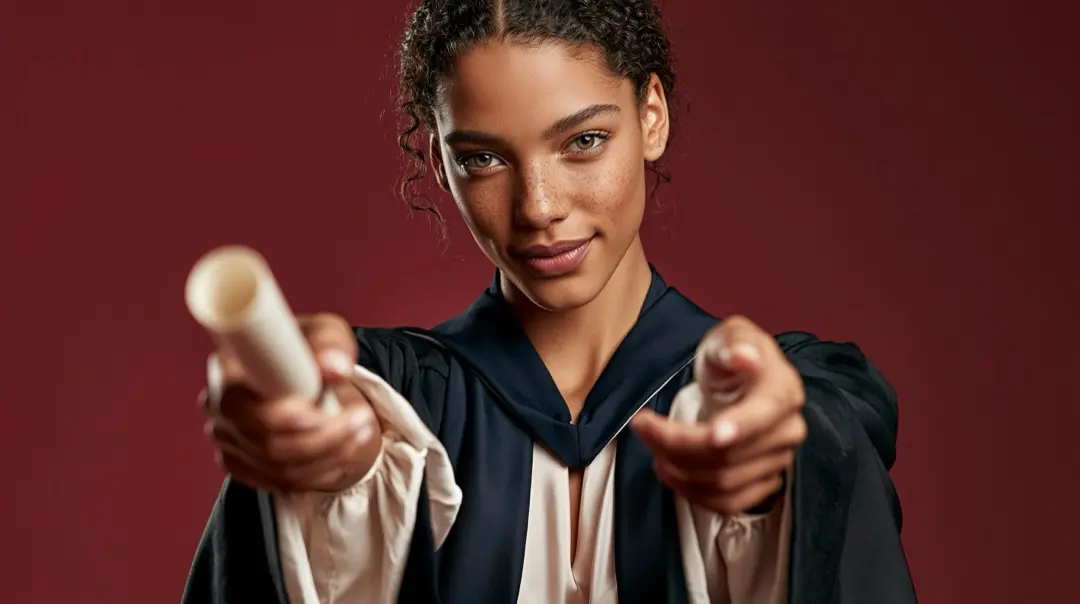
Graduation thank-you song — from the graduate to mom and dad
What to put in the graduation brief (the 5-detail rule)
Five graduation songs in, the pattern is reliable. Songs that hit follow this rule: five details, no feelings.
Their full name and the nickname only you call them
The full name goes in the chorus — that's the moment the graduate hears themselves on a real song. The nickname goes in the bridge, where the song gets quiet. Both make them cry. The right kind of cry.
One specific moment from the early years
Walking into kindergarten and not looking back. Teaching them to ride a bike, the moment you let go of the seat. The first day you watched them lock their own bedroom door. Specific beats generic. Always.
One thing only the two of you would know
The Tuesday playlist. The parking lot conversation. The fight about their major where they turned out to be right. The cafeteria fries. The thing the family group chat still teases them about. This becomes the verse the graduate didn't expect anyone to write down.
What they're walking into next
Nursing school in Knoxville. The dorm in Boston. The job in Austin. The gap year. The graduate program in another country. The song's last verse lives here — the road ahead, named specifically.
What kind of song would actually make them play it twice
Piano. Country. Indie pop. Anthem. Soul. Pick what fits their car-radio energy, not what fits the occasion. A graduation song doesn't have to sound like a graduation song. It has to sound like them.
If you give us five real details about the graduate, the song has a real chance of landing. If you give us "they worked so hard," the song will sound like every other graduation song that's ever been written. We can write specific from specific. We can't write specific from generic.
How to get yours in time for the ceremony
You fill out a brief — five details, two minutes. Pick a music style (or pick "Surprise me" and we'll match the song to the story). Pick a vocal type. Hit submit. The MP3 lands in your email in about 30 minutes, fully editable, free.
If today's slots are full, you can join the notify list and grab one of tomorrow's 10 free slots at midnight EST. Order three days before the ceremony and you'll have it Friday afternoon for a Saturday morning play.
Every song comes with editable lyrics. If something doesn't fit — wrong detail, wrong nickname, wrong tone — you can ask for one round of changes for free.
Make theirs in time for the ceremony
Personalized lyrics · Your music style · Free, delivered in ~30 minutes
Get a free graduation song →No credit card · Even if graduation is this weekend
Questions about graduation songs
More birthday song ideas